Online Fitness Coach vs Workout App
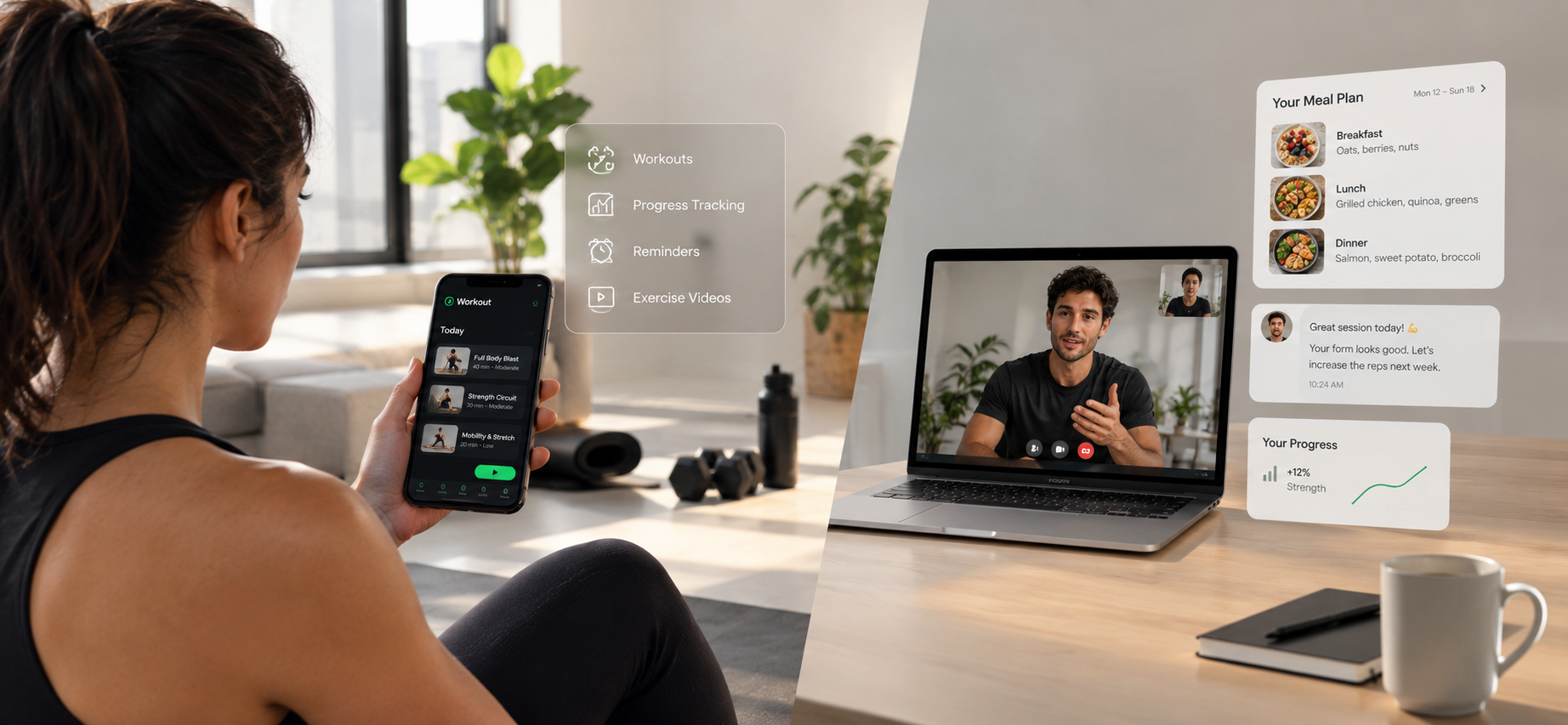
A workout app gives you software, exercise content and tracking. An online fitness coach uses human judgement to build, review and adjust a plan. The right choice depends on whether you need access to workouts or help making decisions.
This page is a product-choice comparison. It does not duplicate the detailed pricing, coach-vetting or effectiveness guides linked below.
Online Personal Trainer vs Fitness App: What Is the Difference?
What a workout app normally provides
A self-guided fitness app may give you:
- A library of workouts
- Exercise demonstration videos
- Training reminders
- Step, distance or activity tracking
- Progress charts
- Standard training programmes
- Automated workout suggestions
- Challenges, badges or community features
Some apps use questionnaires and training data to recommend exercises. This can make the experience more relevant, but automated selection is different from a coach personally reviewing why you missed sessions, whether an exercise causes discomfort or how your routine fits around work and recovery.
Workout apps can be useful tools. The NHS advises that activity-tracking apps can help people become more active, although even a simple written checklist can serve a similar tracking purpose.
What an online fitness coach does
An online fitness coach should begin by learning about your goals, training experience, available equipment, weekly schedule, exercise preferences, relevant limitations, nutrition habits, recovery and previous difficulties with consistency.
The coach then creates or adapts a programme, reviews your training information and provides feedback through messages, check-ins, video calls or exercise recordings. Depending on the package, the coach may also provide suitable nutrition guidance, habit support and progress reviews.
PRSNLI uses this coach-led model. Clients receive personalised workouts and nutrition guidance through the app, while a certified trainer monitors progress and supports consistency. See how PRSNLI personal coaching works.
Coaching software is still an app
Online coaching and fitness apps are not completely separate categories. Most online coaches use an app or platform to deliver workouts, collect check-ins and communicate with clients.
The real comparison is self-guided technology versus technology supported by a real coach.
A well-designed app makes coaching easier to access. It does not replace the judgement, communication or accountability supplied by the person using it.
Personal trainer vs online coaching app
A traditional personal trainer usually provides direct supervision during scheduled sessions. An online coaching app allows a trainer to support your full week through programming, tracking, messages and reviews.
The online model offers more flexibility, but it requires you to exercise independently. Face-to-face training may be more suitable when you need hands-on instruction, physical spotting or close supervision while learning unfamiliar movements.
PRSNLI's guide to getting a personal trainer without joining a gym explains how online, home, outdoor and studio coaching differ.
Fitness App vs Online Coach: Which Gets Better Results?
Personalisation
A workout app may personalise sessions using your goal, experience, equipment and previous performance. The quality of that personalisation depends on the information collected and how the app uses it.
An online coach can also consider information that does not fit neatly into an automated form, such as poor sleep, changing work shifts, discomfort during a movement, missed sessions or declining motivation.
A coach can ask follow-up questions and use judgement. An app usually responds only to the information and rules built into its system.
Better for personalisation: Online coaching.
Accountability
Apps can send reminders, record streaks and display progress. These features may be enough for a self-motivated person.
A coach adds social accountability. Someone notices whether you completed the session, asks what interfered and helps you decide what to change. Useful accountability turns missed sessions into information. If a programme repeatedly fails to fit your life, the coach should help repair the programme.
PRSNLI explains this approach in its guide to whether online personal training actually works.
Better for accountability: Online coaching.
Exercise variety and convenience
Fitness apps often contain large exercise libraries and ready-made programmes. They are available immediately and can be used without arranging a consultation or waiting for feedback.
This makes an app convenient when you want quick workout ideas, a simple running or mobility programme, exercise demonstrations, basic tracking or a low-cost introduction to structured exercise.
A larger library does not automatically produce a better programme. Most clients need a manageable number of suitable exercises performed consistently rather than hundreds of options.
Better for immediate access and variety: Workout apps.
Technique feedback
A demonstration video can show what an exercise should look like, but it cannot confirm that you are performing it correctly.
Some online coaches allow clients to submit recorded exercises for review. The coach can then comment on setup, range of movement and control. Video feedback still has limits and does not provide physical spotting. People learning complex exercises or returning after injury may need in-person support.
Better for individual feedback: Online coaching.
Programme adjustments
An app may increase repetitions, weight or difficulty according to logged performance. This can work when progress follows the expected pattern.
A coach can investigate when the pattern breaks. They may change an exercise, reduce training demands, reorganise the week or decide that the programme should remain unchanged for longer.
Better for contextual adjustments: Online coaching.
Nutrition and lifestyle support
Many fitness apps include calorie targets, meal logging or recipe libraries. These features can help users understand habits, but accurate logging depends on the information entered.
An appropriately qualified coach may help connect nutrition, recovery and training. Advice should remain within the coach's professional scope, with referral to a registered dietitian or healthcare professional where necessary.
PRSNLI provides personalised nutrition coaching alongside exercise and progress tracking.
Better for connected human support: Online coaching.
Cost, Accuracy and Value
Is an online coach worth it compared with a free fitness app?
A free app may be the better choice when you already exercise safely, can follow a suitable programme, stay consistent independently, need only tracking or have a limited budget.
An online coach may justify the additional cost when you repeatedly start and stop, do not know how to structure progression, need a programme built around your schedule or want somebody to review your training.
The value comes from the coach's work, not merely access to another app.
How much do workout apps and online coaches cost?
Prices vary, but a useful UK budgeting comparison is:
| Option | Typical budgeting range | Human support |
|---|---|---|
| Free fitness app | Typical budgeting range£0 | Human supportUsually none |
| Paid workout app | Typical budgeting rangeAround £10–£30 per month | Human supportUsually limited or automated |
| Group online programme | Typical budgeting rangeAround £30–£100 per month | Human supportShared or limited support |
| One-to-one online fitness coach | Typical budgeting rangeAround £100–£250 per month | Human supportPersonal reviews and communication |
| High-touch or specialist coaching | Typical budgeting range£250–£400+ per month | Human supportMore frequent or specialist support |
These ranges are not official tariffs. Compare exactly what each package includes.
PRSNLI's online personal training cost guide explains how check-in frequency, messaging, technique reviews and programme adjustments affect the price.
What is more accurate: health or fitness apps?
Health app and fitness app are broad, overlapping categories, so one type is not automatically more accurate.
Accuracy depends on what is measured, which sensor supplies the data, the activity, how the device is worn, whether information is measured or manually entered and the algorithm used to interpret it.
Research reviews have found that consumer wearables can provide useful information, but accuracy varies by device and measurement. Heart rate and step counting may be more dependable in some conditions than estimates such as energy expenditure or automatic activity classification. A systematic review of wrist-worn trackers found meaningful differences between devices and metrics.
Treat app figures as estimates and trends unless the product has been validated for the particular measurement. A coach cannot make an inaccurate sensor perfectly accurate, but can interpret the data alongside performance, adherence, recovery and feedback.
The hidden cost of unused subscriptions
A £15 app offers poor value if you stop using it after two weeks. A £150 coaching service also offers poor value if communication is weak or the programme does not fit your circumstances.
Before subscribing, check the minimum commitment, cancellation notice, automatic renewal, trial period, review frequency, who answers messages and what happens during illness, travel or injury.
The most economical option is the one you can use consistently and that provides enough support for your needs.
Frequently Asked Questions
It can be if the exercises are simple and the user can train safely. Beginners who need technique correction may benefit from human support.
Apps can change sessions using entered data, but they may not understand context, uncertainty or unusual constraints like a coach can.
The fee pays for human assessment, feedback, decisions, messaging and programme adjustments.
Yes. Many coaches use an app to deliver programmes while remaining responsible for the coaching decisions.
A coach usually offers stronger accountability because a person reviews what happened and responds. An app can provide reminders and streaks, which may be enough for someone who is already self-directed.
The Bottom Line
Choose an app when you mainly need affordable structure and can make safe decisions independently. Choose a coach when the missing ingredient is judgement, accountability and adaptation.
Continue with: Online Fitness Coaching UK | How To Choose An Online Personal Trainer