Can You Get a Personal Fitness Trainer Without Going to the Gym?
.png)
A gym is a location, not a requirement for personal training.
The more useful question is: Where can you train consistently and safely, with the level of support you actually need?
Some people need a trainer beside them. Others need a programme, regular feedback and someone to adjust it. Understanding that difference can prevent you from paying for a service that does not solve your real problem.
Personal Training Without a Gym at a Glance
A mobile trainer brings the session to you. An online coach brings the plan, review and accountability to you.
Can You Really Have a Personal Fitness Trainer Without a Gym Membership?
You do not need a gym membership when the training service does not use a commercial gym.
A qualified personal fitness trainer can programme effective sessions around:
- Your bodyweight
- Resistance bands
- Adjustable dumbbells or kettlebells
- A bench or stable step
- Outdoor walking, running or conditioning
- Household space that can be used safely
- Equipment the trainer brings to each session
Gym access becomes more useful when your goal depends on heavy barbells, specialist machines, a pool, extensive cardio equipment or an environment that motivates you to train.
The absence of a gym does not make a programme ineffective. The programme still needs appropriate exercise selection, progression, recovery and adherence.
Mobile Personal Training | At Home Personal Trainers Near Me
Mobile personal training means the trainer travels to an agreed location, usually your home, garden, residential gym or nearby outdoor space.
This option can suit people who:
- Want immediate exercise feedback without entering a busy gym
- Have a demanding work or family schedule
- Prefer privacy
- Feel uncomfortable in commercial gyms
- Need sessions adapted to a small space
- Want a trainer to bring basic equipment
- Have reliable space but limited time to travel
Current UK mobile services show that at-home sessions can use bodyweight movements, resistance bands, dumbbells, kettlebells and portable benches. Some trainers ask clients to provide only a mat. KB Personal Training describes its home and park model, while Study Active's home-gym guide recommends choosing equipment for the available space and the person's actual goals.
What happens during an at-home PT session?
A responsible first session normally starts with conversation and assessment rather than an exhausting workout.
The trainer may:
- Ask about your goals, exercise history and current routine.
- Discuss injuries, health conditions, symptoms and relevant professional advice.
- Inspect the available floor space and equipment.
- Observe simple movements that match your current ability.
- Explain how future sessions and independent workouts will work.
- Agree how progress, cancellations and communication will be handled.
Ask before booking whether the consultation is separate from the first paid workout.
How much space do you need for home personal training?
Many sessions can work in a clear area large enough to lie down and move your arms and legs without hitting furniture. The exact requirement depends on the exercises.
Before the trainer arrives:
- Clear trip hazards and fragile objects.
- Check ceiling height for overhead movements.
- Keep children and pets away from moving equipment.
- Use a stable, non-slip surface
- Tell the trainer about neighbours or noise restrictions.
- Confirm whether the trainer needs parking or building access.
You do not need to build a complete home gym before your first appointment. Buy equipment only after the trainer explains what the programme will use.
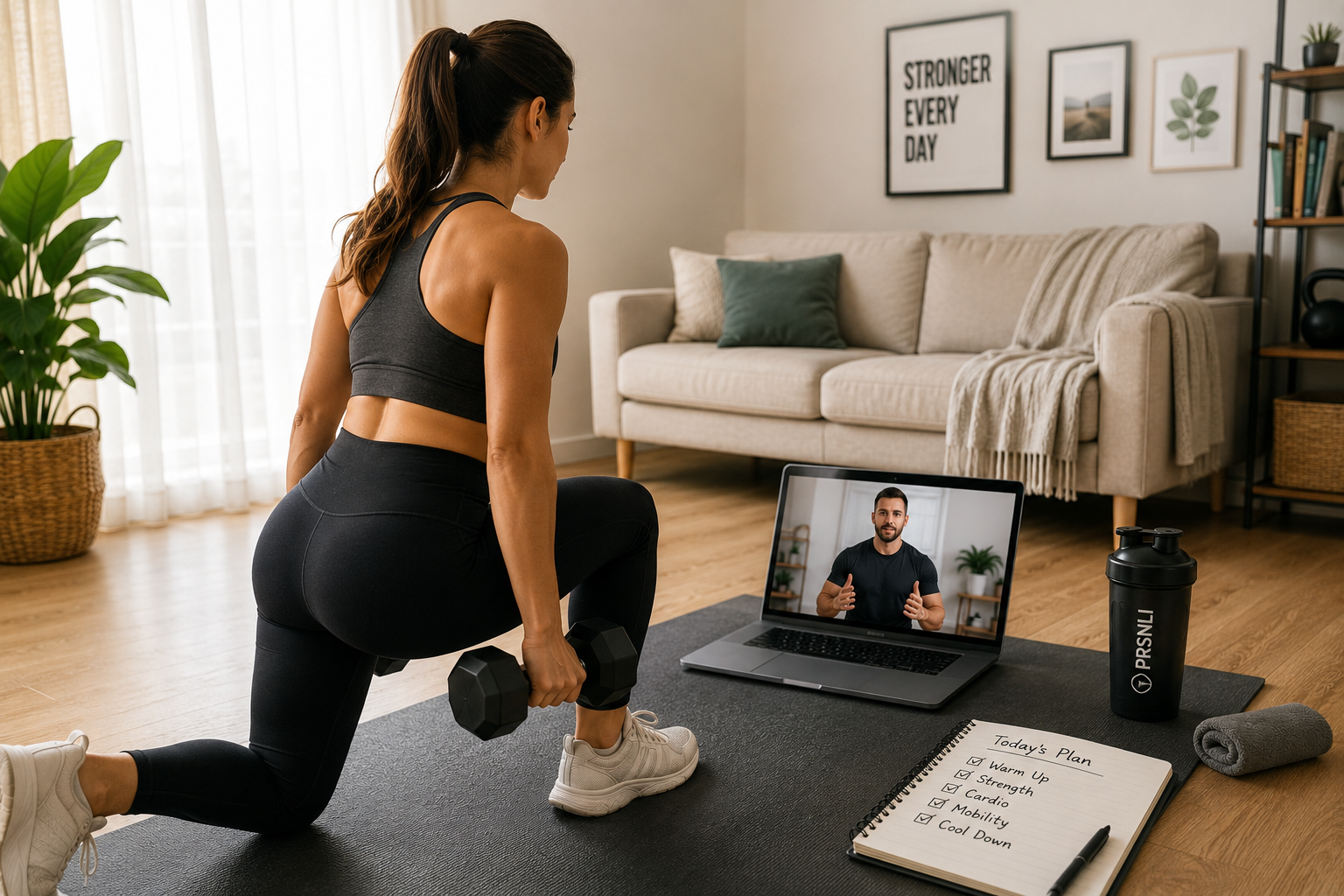
Online Personal Trainer UK: Training Without Sharing a Location
An online personal trainer UK service can mean three different things, so ask which one you are buying.
1. Live virtual personal training
You and the trainer meet on a video call at a fixed time. The trainer watches the session, gives cues and changes the workout in real time.
Live video is the closest remote alternative to an in-person appointment, but the trainer sees only what the camera captures. live online personal training does not provide physical spotting or a full three-dimensional view.
2. Ongoing online coaching
The coach creates a programme for you to complete independently. Support may include workout logging, messages, recorded technique reviews, progress checks, nutrition guidance and regular adjustments.
This service suits people who can exercise safely but need better decisions and accountability across the week.
3. Hybrid personal training
Hybrid coaching combines remote support with selected in-person or live-video sessions. It can help a beginner learn important movements before completing most sessions independently.
Fleming Fitness describes a typical online process involving assessment, a personal plan, progress tracking, feedback and adjustments. TRAINFITNESS also distinguishes self-directed programmes, recorded video feedback and live one-to-one sessions.
Can an online trainer correct your form?
An online trainer can review a recorded set or watch a live video feed. Useful feedback depends on lighting, camera position, image quality and the exercise being performed.
Remote form review is not equivalent to physical supervision. A trainer should recommend in-person instruction when the camera cannot provide enough information or the exercise needs spotting.
How Much Is a 1 Hour PT Session?
There is no official national tariff for personal training in the UK.
As a rough benchmark, PureGym states that a 45 to 60-minute PT session typically costs £30 to £65 outside London and around £45 to £65 in London. Trainers set their own rates, and experience, location, specialism and added support affect the fee. PureGym personal training costs
Mobile personal training may cost more because the fee can include travel, parking, equipment transport and time between clients. Premium London home visits and specialist services can sit well above general gym-based benchmarks.
Before comparing prices, check whether the fee includes:
- Consultation or assessment
- A full 60 minutes of training
- Travel and parking
- Equipment
- A programme for sessions between appointments
- Messaging or check-ins
- Nutrition guidance
- Video review
- Progress measurements
- VAT where applicable
- A minimum package or contract
Calculate the realistic monthly cost
Use 4.33 weeks rather than four when estimating an average calendar month.
Monthly PT estimate = session price x weekly sessions x 4.33
At £50 per session
- One weekly session is approximately £216.50 per calendar month.
- Two weekly sessions are approximately £433 per calendar month.
The cheapest hourly rate is not automatically the best value. Compare what happens between appointments and whether the service helps you become more capable over time.
Coaching Without a Gym: Working From Another Gym
An independent trainer cannot automatically bring clients into any commercial gym.
The trainer may need:
- Written permission from the facility
- A rental, employment or revenue-sharing agreement
- Appropriate professional insurance
- Evidence of qualifications
- A client day pass or membership
- Compliance with the facility's rules
Some trainers rent a private studio or work from another fitness business instead of owning a gym. Others use community halls, sports clubs or dedicated training pods.
Two-Brain Business describes several space-sharing arrangements from the trainer's perspective. Its financial examples are not UK consumer benchmarks, but the central point is relevant: the arrangement must work for the trainer, facility and client.
If a trainer proposes meeting at a third-party gym, ask the facility to confirm permission. Do not assume your ordinary membership allows an external coach to run a paid session.
What Equipment Do You Need Without a Gym?
Start with the programme, not a shopping list.
A good trainer can make a simple setup challenging by changing load, range of motion, tempo, repetitions, sets and exercise complexity.
Equipment should expand the programme, not compensate for a programme that lacks progression.
Does Personal Training Without a Gym Work?
Personal training without a gym can work when the programme matches the person, the available equipment and the training environment.
A 2024 systematic review of 36 trials involving 6,157 older adults found that home-based exercise could improve strength and aerobic fitness. The authors also identified exercise dose and adherence as important weaknesses in many interventions. The evidence was specific to older adults and was not a direct test of commercial personal training. Home-exercise systematic review
A separate review of tele-exercise studies included 16 trials and 1,416 participants. It reported potential improvements in physical fitness and functional outcomes, but study differences limited broad conclusions. Tele-exercise systematic review
These studies do not prove that every home or online trainer is effective. They support a more careful conclusion:
Training location matters less than programme quality, safe execution, appropriate progression and consistent participation.
How to Check a Personal Trainer in the UK
Ask the trainer for qualifications that match the service being offered. A general personal-training qualification does not automatically establish expertise in rehabilitation, clinical nutrition, pregnancy, complex medical conditions or specialist sport performance.
Check:
- Full name and business details
- Relevant personal-training qualification
- Current professional insurance
- Experience with goals similar to yours
- Additional credentials for specialist work
- Health-screening and referral process
- Emergency process for home or outdoor sessions
- Safeguarding and privacy practices where relevant
- Cancellation, travel and bad-weather policies
- How personal and health information is stored
CIMSPA provides a public service for checking verifiable professional status where available. CIMSPA accreditation directory
A trainer should stay within professional scope and refer you to an appropriate clinician when exercise coaching is not enough.
When Is Training Without a Gym Not the Best Option?
Choose in-person gym or clinical support when you need:
- Physical spotting
- Immediate help setting up equipment
- Close supervision during unfamiliar loaded movement
- Specialist machines or heavy weights
- A clinical assessment for pain, injury or concerning symptoms
- A controlled facility because the home environment is unsuitable
- Emergency support that cannot be provided remotely
Seek appropriate medical advice before starting or changing exercise if you have symptoms or a health situation that makes independent training uncertain.
What Is the 3-3-3 Rule Gym?
The 3-3-3 rule has no single standard definition in exercise science.
Current online explanations use the term for several different formats, including:
- Three strength days, three cardio or movement days and three recovery elements
- Three exercises, three sets and three training days each week
- Three exercises completed for three sets or rounds
- Three repetitions, three sets and three minutes of rest for strength work
- A slow three-second tempo for different phases of a repetition
Ask which version a coach means before following it.
The 3-3-3 rule is a memorable planning device, not an official UK guideline. The UK Chief Medical Officers recommend at least 150 minutes of moderate activity or 75 minutes of vigorous activity each week, plus muscle-strengthening activity on at least two days. The guidance was last updated in July 2026. UK physical activity guidelines
A beginner does not need six hard workouts each week. A trainer should adapt frequency and volume to the person's experience, recovery and health.
Which Gym-Free Personal Training Option Is Right for You?
A simple decision test
- Can you perform the planned exercises safely? If not, begin with live in-person instruction.
- Do you mainly need equipment? If yes, a gym or private studio may solve the problem.
- Do you mainly need decisions and accountability? If yes, online coaching may offer better value.
- Will you train at home consistently? If no, choose an environment that creates a reliable routine.
- Can your budget sustain the service? Choose the lowest level of support that reliably solves your barrier.
Questions to Ask Before Hiring a Gym-Free Personal Trainer
- Where will sessions take place?
- Do you have permission to train clients at that location?
- What equipment will you bring?
- What space do I need to provide?
- What qualifications and insurance do you hold?
- How do you screen new clients?
- What happens if I report pain or unusual symptoms?
- Is travel included in the price?
- What happens when the weather is unsafe?
- Will I receive a programme between sessions?
- How often will you review my progress?
- Can I send exercise videos?
- What is your normal response time?
- Is nutrition guidance included and appropriately qualified?
- What is the minimum contract and cancellation notice?
- How is my personal information stored?
- Does AI generate or alter any part of my programme?
- Does a qualified human review automated recommendations?
What Could Change Over the Next Year?
AI-generated programmes will become more common
AI can produce exercise suggestions quickly, but speed is not the same as suitability. Buyers should ask who is professionally responsible for the plan and whether a qualified person reviews changes.
Camera-based form feedback will improve
Phones and wearables will offer more automated movement feedback. These tools can flag visible patterns, but camera position and software error still limit their reliability. They do not provide physical spotting.
Hybrid coaching will become easier to buy
More services are likely to combine an app, coach messaging, live video and occasional local sessions. Compare the number of genuine human reviews rather than the number of features.
Data questions will matter more
Training apps can collect workout, nutrition, body and health-related information. Ask what is collected, where it is stored, who can access it and how to delete it.
Portable equipment will keep improving
Adjustable weights, connected resistance equipment and compact home systems can make progressive training easier in limited space. Equipment still needs a suitable programme and safe setup.
The Verdict
You can get a personal trainer without going to the gym.
Choose mobile or at-home personal training when you want privacy, convenience and immediate feedback. Choose live online PT when you want a fixed appointment without travel. Choose ongoing online coaching when you can train safely but need programming, accountability and regular adjustments. Choose hybrid coaching when you need both flexibility and occasional live instruction.
The best location is the one in which you can train safely and consistently.
Prsnli is relevant for people who want coach-led training, nutrition guidance, progress tracking and support in one remote service. You can explore how Prsnli personal coaching works and compare it with the level of live supervision you need.